Introduction
In this project we are making a garbage disposal system. Taking the help of modern engineering and technology, the proposed automatic garbage disposal system helps to make a pollution free and less energy consuming town. Here garbage disposal system uses belt conveyor system.
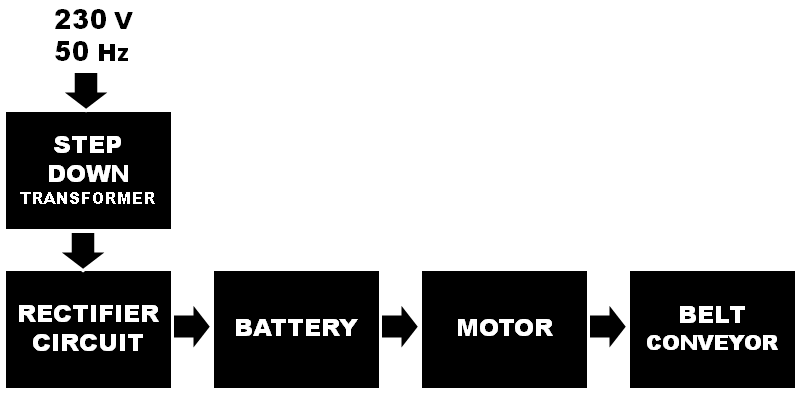
Block Diagram
Materials required
- Transformer
- Diode
- Capacitor
- Hard board
- LED
- Connecting wires
- Screws
- Frames
- Stickers
- Resistors
- Switch
- Motor
- battery glue
- belt
- bins
Components Description
Resistor
A resistor restricts the flow of current. The resistors used here are carbon film and quarter watt type.
Capacitor
A capacitor stores electric charge. Capacitors used here are electrolytic and ceramic type.
LED (Light Emitting Diode)
It is a transducer which converts electrical energy into light energy.
Diode 1N4007
These are general purpose diodes. These diodes have high current capability and low forward voltage drop. The average rectified output current is one ampere.
7805 voltage regulator
The 7805 voltage regulator IC gives us a constant 5 volt DC power supply from a 12 volt rectified output voltage. So, where the rest of the 7 volt goes? Actually, the rest 7 volt goes nowhere. It is dissipated as heat in the heat sink provided to the voltage regulator IC.
Transformer
It consists of two coils of insulated copper wire linked by an iron core. Transformers are used to step up (increase) or step down (decrease) AC voltages. Energy is transferred between the coils by the magnetic field in the core. There is no electrical connection between the coils. Here we have used a shell type step down transformer which step downs 230 volt AC to 12 volt AC. It can supply maximum 1A current.
Motor
A motor is a device which converts electrical power into mechanical power. Here we have used a BO Motor. BO stands for Battery Operated. BO motors are suitable for electronics hobby activities especially for small projects. It consists of small DC motor with gear arrangement to increase the torque. It is used in many DIY Robotic applications that are operated through batteries.
Working

The transformer steps down the 230 volt AC into 12 volt AC. The bridge rectifier converts 12 V AC into 12 V DC and filtered by the 1000 µF capacitor. The LED in series with 1 kΩ resistor is just for power indication purpose. The 5V output is connected to a 4V lead acid battery terminals for charging. A diode is connected in series with the positive output of voltage regulator and positive terminal of 4 V battery to avoid continuous glowing of power indicator even when we are not charging.
In this process a moving belt associated with dustbins carries the solid waste and below the belt liquid waste flows. The public have to use belt conveyor system to dispose their waste materials without throwing here and there. This system transports the waste materials from one location to other. By allotting specific time, different waste materials can be gathered differently. So, the mixing problem of waste materials is eliminated here.
Belt conveyor system
A belt conveyor system is that which consists of two or more pulleys and a carrying medium. The carrying medium may be a metal or rubber belt. It has an endless loop of. The conveyor belt rotates about the pulleys. Conveyors are durable and reliable components. In a belt conveyor system one or both of the pulleys are powered to move the belt and the public on the belt.
Drive pulley- The powered pulley is called the drive pulley.
Idler pulley – The unpowered pulley is called the idler pulley.
Advantages
- A clean living place can be created
- Less amount of energy is spent in the transportation.
- No conventional power is utilized if the power is generated by using solar cells to feed the motors.
- It can reduce the number of dustbins and municipal workers.
- Blockage of drains are avoided
- Bio-degradable and Bio-non-degradable wastes are separately dumped.
- The mixing of solid wastes with liquid wastes is prevented and avoids pungent smell.
Future expansion
The power can be generated to feed the motors by using solar cells or any non-conventional sources.
One Reply to “Automatic Garbage Disposal System.”
Leave a Reply
Related Posts

Automatic Flood Resistant House.
Introduction : Considering the harmful effects of flood, we have…

By using this method, bio-degradable and bio-non-degradable wastes are easily separated and dumped