
Abstract
Water is one of the most essential natural resources for all living organisms. However, increasing water consumption, wastage, irregular rainfall, and declining groundwater levels have made water conservation an important responsibility.
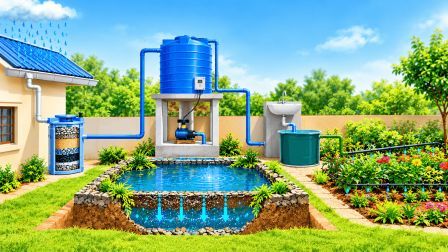
The science project “EVERY DROP COUNTS” demonstrates an integrated system for collecting, storing, conserving, filtering, and reusing water. It combines rainwater harvesting, an automatic overhead water tank control system, a rainwater filtration model, a pond for groundwater recharge, and a wastewater collection system for garden irrigation.
A real bistable multivibrator circuit is used to control the water pump automatically when the overhead tank reaches its full level. Rainwater collected from a rooftop is directed through a pipe into a storage tank. A filter model demonstrates the removal of some suspended impurities from collected rainwater. A pond model illustrates how stored rainwater can help replenish groundwater. In addition, used water from a wash basin is collected separately for reuse in watering plants.
The project promotes the idea that water conservation requires not only saving water but also collecting rainwater, preventing overflow, improving storage, and reusing suitable wastewater. It demonstrates how science, electronics, and environmental awareness can work together to support sustainable water management.
Introduction
Water is essential for drinking, cooking, agriculture, sanitation, industry, and the survival of plants and animals. Although water covers a large part of the Earth’s surface, only a limited proportion is readily available as usable freshwater. In many places, water is wasted because of overflowing tanks, improper water management, and the failure to collect rainwater. At the same time, excessive extraction of groundwater can lower the water table.
The project “EVERY DROP COUNTS” presents a practical approach to these problems. It combines several water-saving methods in one working model to show how every drop can be collected, stored, managed, and reused wherever appropriate. The project also demonstrates the usefulness of electronic circuits in solving everyday problems. An automatic pump-control circuit helps prevent overhead tank overflow, while rainwater harvesting and water reuse help reduce the unnecessary consumption of freshwater.
Materials Used
The model includes the following materials:
A baseboard and materials for constructing the miniature buildings and landscape.
Sunboard
Pipes or flexible tubes for carrying water.
Plastic containers representing the overhead tank, rainwater storage tank, and wastewater collection tank.
A small water pump.
A bistable multivibrator circuit with suitable electronic components.
Water-level sensing arrangements compatible with the control circuit.
Connecting wires
power supply
ic 555
relay
Filter materials such as gravel, sand, and wood charcoal.
Materials for constructing a miniature pond and garden.
A miniature wash basin and suitable water collection pipes.
Plants or artificial greenery for the garden.
Adhesive and other decorative materials.
Description and Working Principle
The project consists of five major systems that work together to demonstrate efficient water management.
1. Automatic Overhead Tank Control Using a Bistable Multivibrator
The overhead tank is connected to a small water pump controlled by a real bistable multivibrator circuit. A bistable multivibrator is an electronic circuit with two stable states. It can remain in either state until an appropriate input signal changes it to the other state.
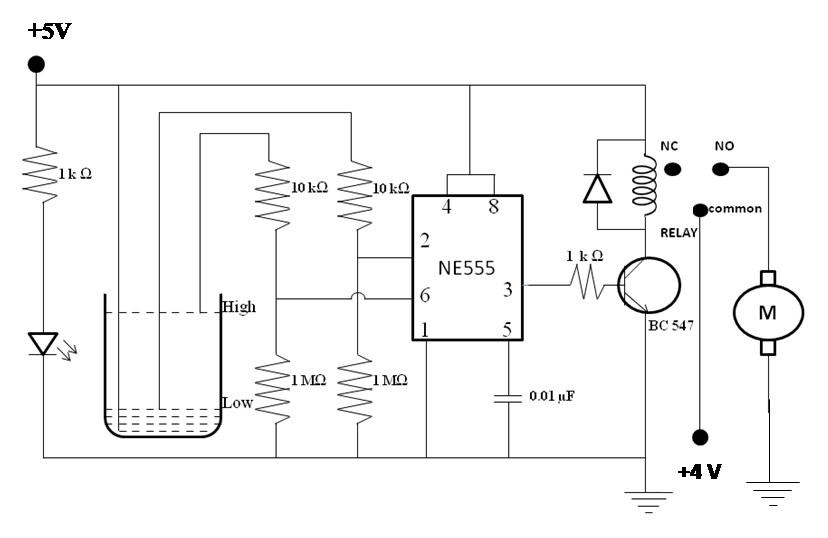
In this project, the circuit is used as a control unit for the pump. Water-level sensing arrangements provide signals corresponding to the tank’s water level. When the water level reaches the specified full-level point, the circuit changes state and switches off the pump through a suitable relay driver. When the system receives the appropriate signal to start filling again, the circuit can switch the pump back on.
This arrangement demonstrates how electronic control can reduce water wastage caused by an overflowing overhead tank.
Working sequence:
The pump starts filling the overhead tank when the circuit receives the appropriate start signal.
Water gradually rises inside the tank.
The water-level sensing arrangement detects the full-level condition.
The bistable multivibrator changes its output state.
The relay driver turns off the pump.
The pump remains off until the circuit receives the appropriate restart signal.
The exact start and stop behaviour depends on the sensing arrangement and circuit connections used in the model.
Scientific principle: A bistable circuit stores a control state and can be used to control an electrical load through a suitable switching stage.
2.Rainwater harvesting is the process of collecting and storing rainwater for future use.
In the model, a rooftop represents the rainwater collection surface. During rainfall, water falling on the roof flows into a collection pipe. The pipe directs the water into a plastic storage tank.
The stored water can be used for suitable purposes such as gardening, cleaning, and other non-drinking activities. Depending on the quality of the collected water and the treatment provided, additional uses may be possible. A practical rainwater harvesting system may also include a mesh screen, a first-flush arrangement to divert the initial roof runoff, and a covered storage tank to reduce contamination.
Scientific principle: Rainfall can be collected from an appropriate surface and stored instead of allowing all of it to run off unused.
3. Rainwater Filtration Model
The filtration section demonstrates how collected rainwater can pass through layers of filtering materials before entering a storage container. The model use gravel, sand, and wood charcoal. Gravel helps retain larger particles, while sand and charcoal can remove some smaller suspended impurities. The water is then collected in a separate container for drinking purpose. This part of the project explains the importance of improving water quality before use.
Scientific principle: Filtration separates certain suspended impurities from water by passing it through porous materials.
4. Pond Model for Groundwater Recharge
The pond section demonstrates the role of surface water storage in groundwater conservation.
Rainwater is collected into a pond, where it can be temporarily stored. In a suitable real-world location, some of this water can gradually infiltrate the soil and recharge underground water-bearing layers called aquifers. Groundwater recharge depends on factors such as soil permeability, geology, the depth of the water table, and the quality of the water entering the ground. Ponds and recharge structures can therefore help reduce runoff and support groundwater replenishment when properly designed and maintained.
Scientific principle: Infiltration is the movement of water from the ground surface into the soil. Some infiltrated water may eventually contribute to groundwater recharge.
5.Wastewater Collection and Garden Reuse System
The fifth section represents the collection and reuse of suitable wastewater. A miniature wash basin is connected to a separate plastic container by a pipe. Water used at the basin flows into this container instead of being discarded immediately. The stored water can then be used to demonstrate watering plants in the garden section. This system illustrates the reuse of water for a purpose that does not require drinking-water quality. In real homes, suitable water from activities such as hand washing may sometimes be reused for irrigation, provided the water does not contain harmful chemicals or excessive contaminants.
Scientific principle: Reusing suitable water for a secondary purpose can reduce the demand for fresh water.
Advantages of the Project
- Demonstrates practical methods of water conservation.
- Helps prevent overhead tank overflow through automatic pump control.
- Encourages the collection and storage of rainwater.
- Introduces the basic principles of water filtration.
- Explains the importance of ponds and groundwater recharge.
- Demonstrates the reuse of suitable wastewater for gardening.
- Integrates technology with environmental science.